My Uncle Raised Me After My Parents Died – Until His Death Revealed the Truth He’d Hidden for Years
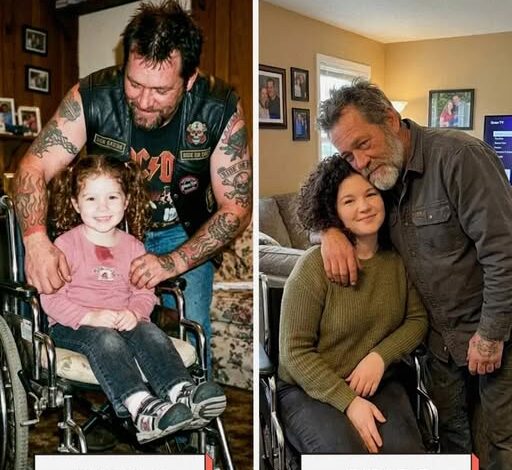
A Final Letter Reveals Hidden Truth and Fuels One Woman’s Journey Toward Standing Again
The Silence That Followed
At 26, Hannah stood in the quiet aftermath of her uncle’s funeral, surrounded by half-cleared dishes and fading condolences. The house, once filled with visitors and low murmurs of sympathy, settled into a silence that felt permanent.
As guests drifted away, a family friend approached her with a sealed envelope bearing her name in her uncle’s unmistakable handwriting.
“Your uncle asked me to give you this,” she said softly. “And to tell you he’s sorry.”
The apology lingered in Hannah’s mind long before she opened the letter.
A Childhood Shaped by Loss
Hannah had not walked since she was four years old. While many assumed her life began in a hospital bed, she remembered fragments from before the accident that changed everything.
She remembered her mother singing loudly while cooking and her father returning home smelling of motor oil and peppermint gum. There were flashes of childhood details: light-up sneakers, a purple cup, and the confidence of a young child who believed the world was steady.
Then came the crash.
The version she grew up hearing was straightforward: a car accident claimed her parents’ lives, and she survived with a spinal injury that left her unable to walk.
A Decision That Changed Her Future
In the hospital, social workers discussed her placement into foster care. That conversation ended abruptly when her uncle Ray walked into the room.
He was direct and unwavering.
“No,” he said.
When told procedures required discussion, he responded firmly: “I’m taking her. I’m not handing her to strangers. She’s mine.”
Ray had no experience raising a child, and certainly none raising a child with a spinal injury. But he took her home.
A Home Built on Determination
The small house smelled like coffee and motor oil. It wasn’t designed for a wheelchair, and nothing about it was perfect, but it became hers.
Ray learned by observing nurses and asking questions. He filled a worn notebook with instructions on repositioning her safely, monitoring her health, and managing daily routines.
On her first night home, he set alarms every two hours to turn her and prevent pressure sores.
“Pancake time,” he would murmur, gently repositioning her. If she whimpered, he reassured her quietly, “I know. I got you, kiddo.”
Everyday Acts of Care
Ray built a plywood ramp at the front door. It was uneven but functional.
He argued with insurance representatives when necessary equipment was delayed or denied.
When children stared at her in public, he knelt beside her and said confidently, “Her legs don’t listen to her brain. But she can beat you at cards.”
He braided her hair awkwardly, learned about makeup through online tutorials, and washed her hair carefully in the kitchen sink.
Whenever she questioned her place in the world, he would say firmly, “You’re not less. You hear me? You’re not less.”
Expanding a Limited World
Although her physical world felt small at times, Ray worked to expand it. He lowered shelves so she could reach them and welded a custom tablet stand in his garage.
When she once mentioned wishing for fresh herbs after watching cooking shows, he built a planter box by the window.
The day the basil sprouted, she cried.
“Jesus, Hannah, you hate basil?” he asked in alarm.
“It’s perfect,” she said through tears.
A Devastating Diagnosis
Years later, Ray began to slow down. He paused on the stairs and burned dinner more than once. He dismissed concerns with a quiet insistence that he was fine.
He was 53 when doctors confirmed the diagnosis: stage four cancer.
Hospice care soon followed. Medical equipment filled the home, and schedules replaced routines.
The night before he died, he sat beside her bed.
“You know you’re the best thing that ever happened to me, right?” he said.
“That’s kind of sad,” she tried to joke.
“Still true.”
When she admitted she didn’t know how to live without him, he replied, “You’re gonna live. You hear me? You’re gonna live.”
Before leaving the room, he added quietly, “I’m sorry. For things I should’ve told you.”
The Hidden Truth in the Letter
After the funeral, Hannah opened the envelope.
“Hannah, I’ve been lying to you your whole life. I can’t take this with me.”
The letter revealed that the night of the crash had unfolded differently than she believed.
Her parents had brought her overnight bag to Ray’s house. They were planning to move to a new city and intended to leave her behind temporarily.
“They said they weren’t taking you,” he wrote. “Said you’d be better off with me because they were a mess. I lost it.”
He described the argument, admitting he had shouted accusations and harsh words.
“I knew your dad had been drinking,” he wrote. “I saw the bottle. I could’ve taken his keys. Called a cab. Told them to sleep it off. I didn’t. I let them drive away angry because I wanted to win.”
Twenty minutes later, police called.
“Car wrapped around a pole. They were gone. You weren’t.”
Guilt and Redemption
Ray admitted that when he first saw her in the hospital, he felt something he later regretted.
“At first, when I saw you in that hospital bed,” he wrote, “I looked at you and saw punishment. For my pride. For my temper. I’m ashamed to say that sometimes, in the beginning, I resented you. Not for anything you did. Because you were proof of what my anger cost.”
Taking her home, he wrote, was the only right decision left to make.
Everything he did afterward was an attempt to repay what he felt he owed.
A Carefully Protected Future
The letter also revealed that financial struggles she believed were constant had been intentional safeguards. Ray had placed her parents’ life insurance in his name to avoid state intervention.
He worked overnight shifts as a lineman to maintain stability.
The remaining funds, he wrote, had been placed in a trust for her.
“The lawyer’s card is in the envelope. I sold the house. Your life doesn’t have to stay the size of that room.”
His final words carried both apology and love.
“If you can forgive me, do it for you. So you don’t spend your life carrying my ghost. If you can’t, I understand. I will love you either way. I always have. Even when I failed.”
A Step Toward Standing Again
Weeks later, after legal meetings and paperwork, Hannah entered a rehabilitation center.
Her physical therapist reviewed her history carefully.
“This is going to be rough,” he said.
“I know,” she replied. “Someone worked really hard so I could be here. I’m not wasting it.”
Secured in a harness over a treadmill, her legs trembled as they were guided into motion.
“You okay?” the therapist asked.
“I’m just doing something my uncle wanted me to do,” she answered.
They tried again after each stumble.
Finding Strength in Motion
Recently, for the first time since childhood, she stood bearing most of her own weight for several seconds.
It was unsteady and emotional, but she felt the floor beneath her.
In her memory, she heard his voice: “You’re gonna live, kiddo.”
Forgiveness in Progress
Hannah acknowledges that forgiveness is complicated.
Some days, anger surfaces at what might have been prevented. Other days, memories of care and devotion rise to the forefront.
She remembers hands steadying her shoulders, awkward braids, and the planter box filled with basil.
Over time, she has come to understand that forgiveness is not a single moment but a gradual process.
Carrying the Journey Forward
Ray did not run from his mistakes. Instead, he devoted his life to caring for the child who survived.
He carried her as far as he could.
Now, the remaining distance belongs to her.
Through rehabilitation and determination, Hannah continues to pursue strength and independence, guided by both truth and love.